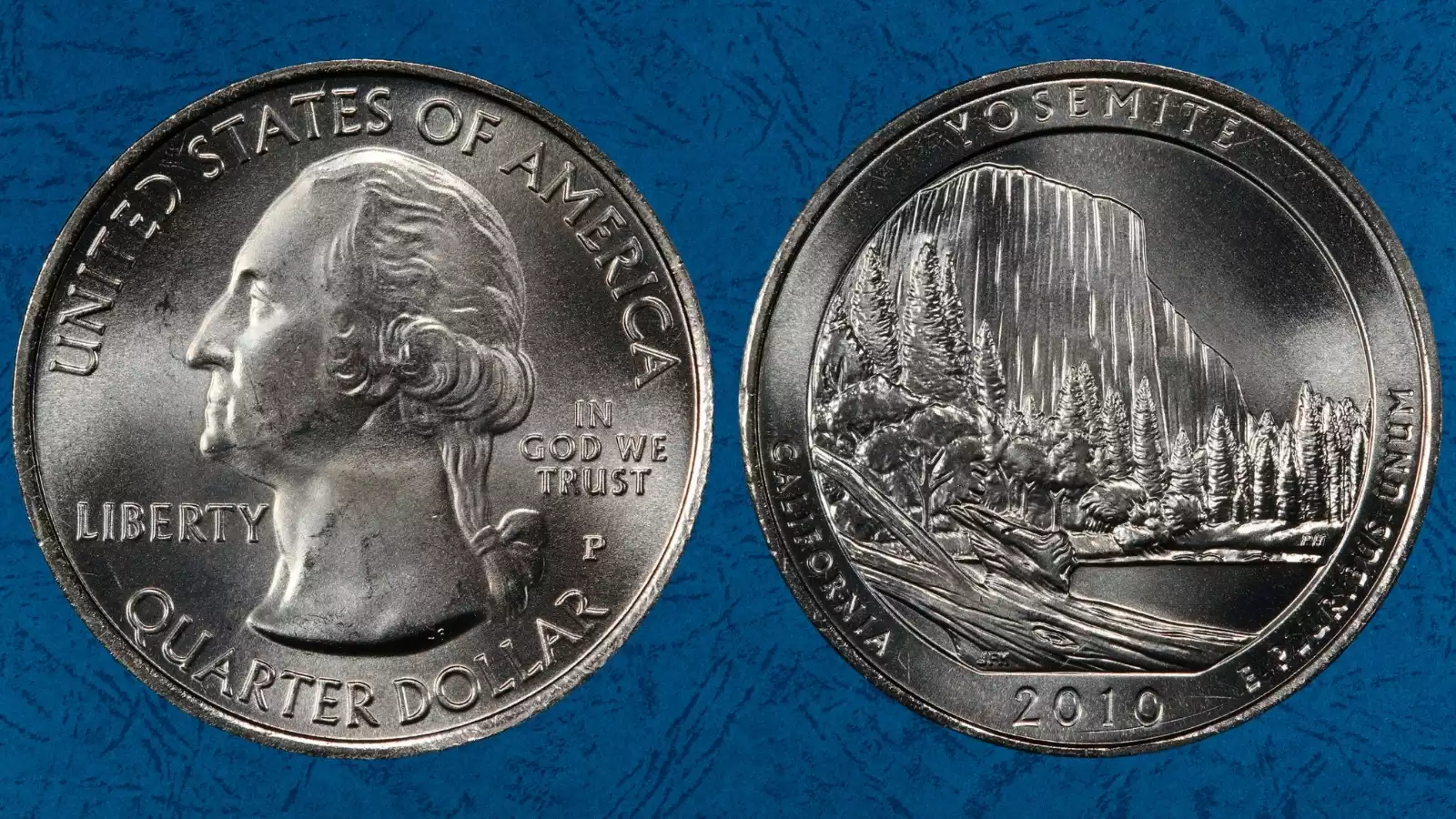
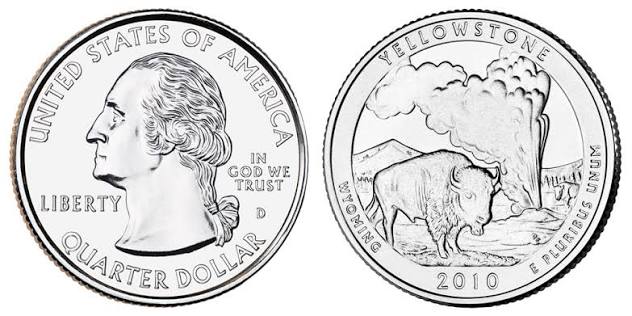
2010 America the Beautiful quarter obverse and reverse showing Washington portrait and Yellowstone Old Faithful design

The Real 2010 Quarter Value: What Your America the Beautiful Quarter Is Worth

A 2010-D Yellowstone quarter in MS67 grade sold for $1,140 at Heritage Auctions — while most 2010 quarters sit in pocket change at face value. Error varieties like clipped planchets have hit $1,100+, and top-grade Grand Canyon specimens fetch close to $1,000. The difference between a 25-cent coin and a four-figure collectible often comes down to mint mark, condition, and knowing what to look for.

★★★★★ 4.8 / 5 from 1,423 collectors
Check My 2010 Quarter Value →
$1,140
Top auction sale
(2010-D Yellowstone MS67)
~347M
Total 2010 quarters
minted (circulation)
$1,100
Top error coin sale
(clipped planchet MS65)
5
National park designs
released in 2010

2010 Quarter Value Chart at a Glance

Values below are based on recent market data from PCGS, NGC, Heritage Auctions, and GreatCollections. For a thorough step-by-step breakdown of identification factors that affect pricing, consult this complete 2010 quarter identification reference guide. The Yellowstone row is highlighted — it holds the top regular-issue auction record. Grand Canyon in high MS grades is highlighted as the other standout performer.

Design / Mint Worn (G-VF) Circulated (AU) Uncirculated (MS60-64) Gem (MS65+)
Hot Springs P $0.25 $0.35 – $1 $2 – $12 $12 – $32
Hot Springs D $0.25 $0.35 – $1 $2 – $15 $15 – $73
⭐ Yellowstone P $0.25 $0.35 – $1 $2 – $25 $25 – $590
⭐ Yellowstone D $0.25 $0.35 – $1 $2 – $132 $132 – $1,140
Yosemite P $0.25 $0.35 – $1 $2 – $10 $25 – $210
Yosemite D $0.25 $0.35 – $1 $2 – $10 $25 – $410
🔴 Grand Canyon P $0.25 $0.35 – $1 $2 – $25 $25 – $2,300
🔴 Grand Canyon D $0.25 $0.35 – $1 $2 – $20 $25 – $1,150
Mount Hood P $0.25 $0.35 – $1 $2 – $8 $15 – $130
Mount Hood D $0.25 $0.35 – $1 $2 – $8 $15 – $410
S Clad Proof DCAM $3 – $23 (per design)
S Silver Proof DCAM $9 – $36 (per design)

⭐ = Signature variety (Yellowstone D). 🔴 = Highest potential value in top gem grades (Grand Canyon P MS68+). Values based on PCGS auction data and recent market activity.

🪙 CoinKnow lets you snap a photo of your 2010 quarter and get an instant value estimate on the go — a coin identifier and value app.

The Valuable 2010 Quarter Errors (Complete Guide)

The 2010 America the Beautiful quarters were produced in the hundreds of millions, and with that volume comes a documented set of minting errors that can transform a common quarter into a serious collectible. The five error varieties below are ranked by documented auction performance — from the most famous to the stealthiest find. Each was confirmed at a major auction house or professional grading service. Use the sidebar to jump directly to any variety.

MOST VALUABLE

2010 Quarter Clipped Planchet Error

$50 – $1,100+ 2010 quarter clipped planchet error showing curved missing section at coin rim
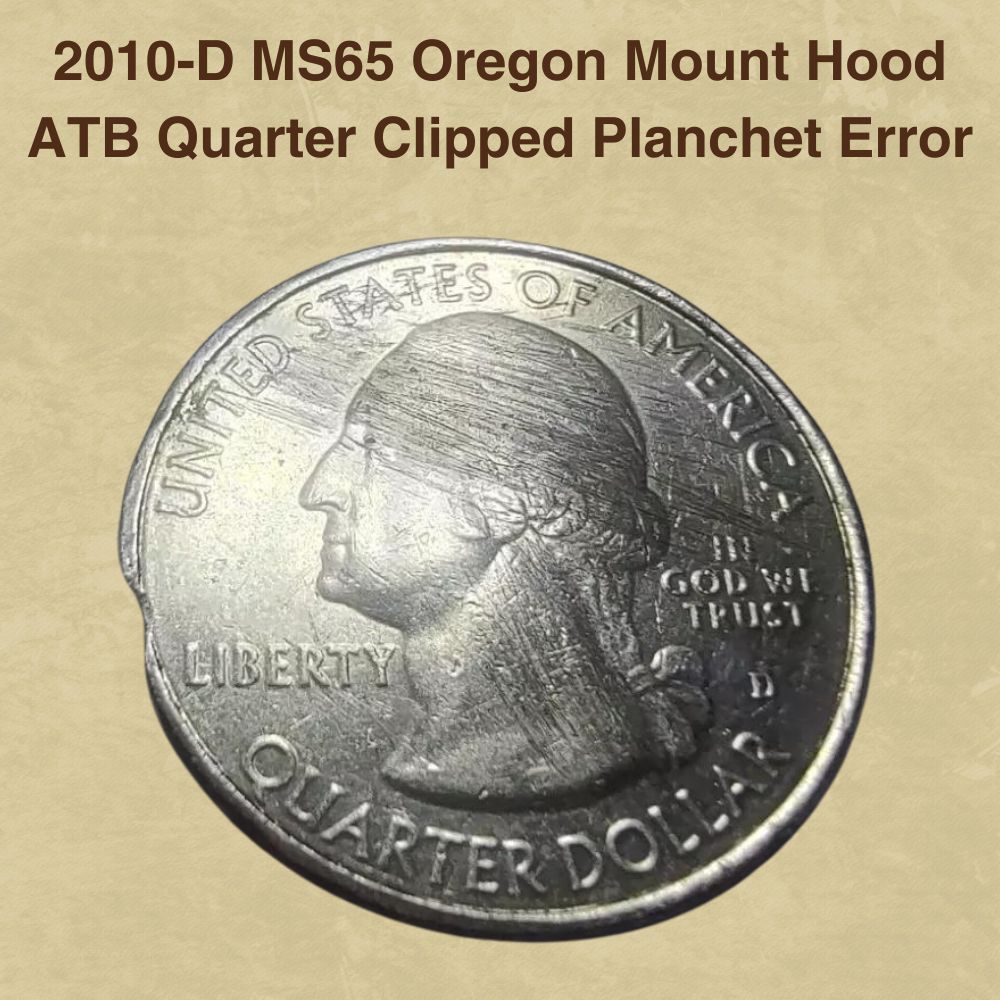
A clipped planchet occurs when the metal strip feeding into the coining press overlaps a hole left by the previous planchet punch, resulting in a coin with a curved or straight section physically missing from its edge. The 2010 series produced documented examples of both curved clips (the most common type) and, less frequently, straight clips caused by a misaligned punch cutting across a flat portion of the strip.

Visually, the error produces a clearly identifiable crescent-shaped or straight bite out of the coin's circumference. Collectors should also examine the opposite side from the clip for the "Blakesley Effect" — a region where the rim and nearby design elements appear noticeably weak or absent due to metal flow disruption during the strike. Presence of the Blakesley Effect is a key authenticity indicator that distinguishes genuine clipped planchets from damaged or filed coins.

The 2010-D Mount Hood quarter with a prominent curved clip graded MS65 realized $1,100 at a 2022 auction — the highest confirmed sale for any 2010 quarter error and one of the strongest results for any America the Beautiful error coin. Collector demand is driven by the dramatic visual impact and the relative difficulty of finding such examples in true Mint State condition, since the edge weakness often leads to contact marks during handling.

How to spot it Hold the coin at eye level and rotate it slowly under light. A genuine clipped planchet shows a smooth, curved (or straight) missing section with rounded interior edges — not sharp breaks typical of damage. Check the rim directly opposite the clip for weak or missing detail (Blakesley Effect) using a 10× loupe.
Mint mark Confirmed on D (Denver) — 2010-D Mount Hood. Curved clips reported on P (Philadelphia) issues as well. S (San Francisco) proofs not documented with this error.
Notable A 2010-D Mount Hood curved clip in MS65 sold for $1,100 at GreatCollections in 2022 — the highest auction result for any 2010 quarter error. Larger clips with clear Blakesley Effect command the highest premiums. Authenticate via PCGS or NGC before selling to rule out post-mint damage.
MOST FAMOUS

2010 Quarter Die Crack Error

$100 – $1,040+ 2010 Hot Springs quarter die crack error showing raised irregular line crossing Washington's portrait
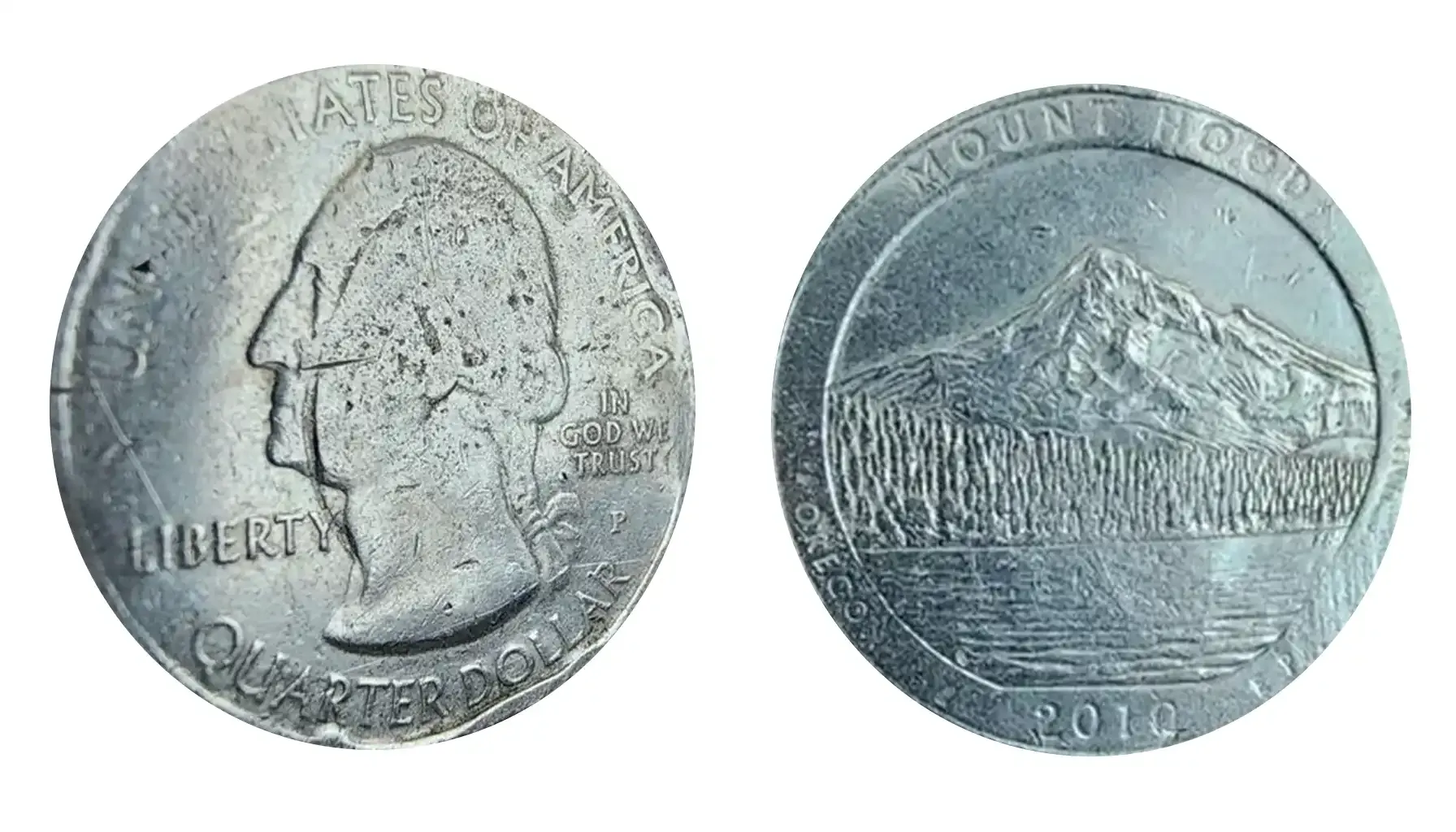
Die crack errors form when the hardened steel working die develops hairline fractures under the immense pressure of striking hundreds of thousands of coins. Metal flows into these fractures during each strike, transferring as raised, irregular lines across the coin's surface. On the 2010 America the Beautiful series, die cracks have been documented on both the obverse Washington portrait and the reverse national park designs, with the most valuable examples running prominently across Washington's portrait or face.

The diagnostic feature is the raised, jagged line running across the coin's design — unlike a scratch or post-mint damage, die cracks are always raised above the coin's surface because they represent metal that filled the crack in the die. Under a 10× loupe, the crack line will follow the die's stress fracture pattern, which typically runs from a high-pressure point (such as the rim or a lettering serif) across the field.

Heritage Auctions sold a 2010-D Arkansas Hot Springs quarter graded MS63 bearing a large die crack across Washington's portrait for $1,040 — one of the most publicized 2010 quarter error sales. The cracking pattern — described by one dealer as making Washington appear to be "sneezing" — added novelty appeal on top of the numismatic premium. Smaller, less dramatic die cracks on lower-grade examples still fetch $100 to $300 depending on visibility and coin grade.

How to spot it Under a 10× loupe, look for a raised, irregular line crossing the coin's surface — die cracks are always raised, never incuse. Trace the line's path; genuine cracks often start at the rim or a high-relief lettering point and extend across the field or portrait. Post-mint scratches are incuse (cut into the surface) and have sharp, linear edges.
Mint mark Confirmed on D (Denver) — 2010-D Hot Springs MS63. Also reported on P (Philadelphia) Hot Springs and Grand Canyon issues at lower grades.
Notable A 2010-D Hot Springs quarter with a prominent die crack across Washington's portrait sold for $1,040 at Heritage Auctions in MS63 grade. A 2010-P Grand Canyon die crack variety is also documented. Large, portrait-crossing cracks consistently achieve the highest premiums. Smaller rim cracks on the same design sell for $100–$300.
RAREST

2010 Quarter Doubled Die Error (DDO/DDR)

$50 – $705+ 2010 Grand Canyon quarter doubled die error showing doubling on design elements
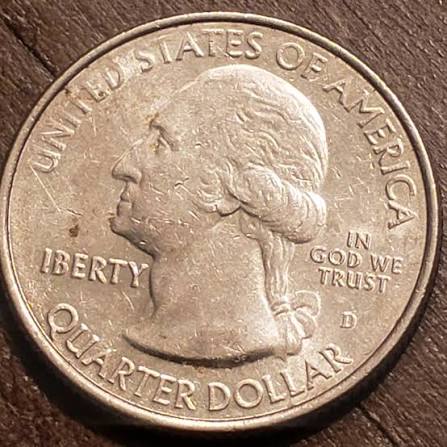
A doubled die error results from a misalignment during the hubbing process, where the working die receives multiple impressions from the master hub at slightly different positions or rotations. Each element struck into the die from the offset hub produces a slight secondary image, visible on the finished coin as doubling of design elements, lettering, or the date. On 2010 America the Beautiful quarters, both obverse doubled die (DDO) and reverse doubled die (DDR) varieties have been documented and confirmed by collectors and grading services.

The most sought-after 2010 doubled die is found on Grand Canyon quarters from the Denver Mint, where doubling appears on the reverse design elements. A separate DDR variety has been noted on some 2010 Hot Springs quarters, where doubling shows on the reverse legends. Inspect the lettering of "UNITED STATES OF AMERICA," "QUARTER DOLLAR," and "IN GOD WE TRUST" under a 10× loupe — doubled die separation will appear as distinct secondary lines, not the blurry die deterioration doubling (DDD) that is far less valuable.

GreatCollections sold a 2010-D Grand Canyon quarter graded MS65 with a confirmed doubled die error for $705 in 2020, making it one of the best-documented high-grade doubled die sales in the series. Values for doubled die 2010 quarters range from $50 to $150 for Hot Springs DDR examples depending on grade, and $200 to $705+ for the more prominent Grand Canyon DDO/DDR in MS65 and above. True doubled die must be distinguished from machine doubling, which shows flat shelf-like doubling with no collector premium.

How to spot it Under a 10× loupe, examine the reverse legends and "IN GOD WE TRUST" on the obverse. Genuine doubled die shows distinct, rounded secondary outlines offset from the primary design — not flat, shelf-like mechanical doubling. Separation should be visible with the naked eye on strong examples; weaker DDR shows only under magnification.
Mint mark DDO/DDR confirmed on D (Denver) Grand Canyon MS65 and P (Philadelphia) Hot Springs. Denver Grand Canyon is the most documented and highest-value variety in the series.
Notable A 2010-D Grand Canyon quarter with doubled die sold for $705 at MS65 through GreatCollections in 2020 — one of the most referenced 2010 ATB error sales. Hot Springs DDR examples fetch $50–$150. Confirm with CONECA attribution before submitting to grading services to maximize realized price.
BEST KEPT SECRET

2010 Quarter Rim Cud Error

$50 – $620+ 2010 Hot Springs quarter rim cud error showing raised formless blob at the coin edge
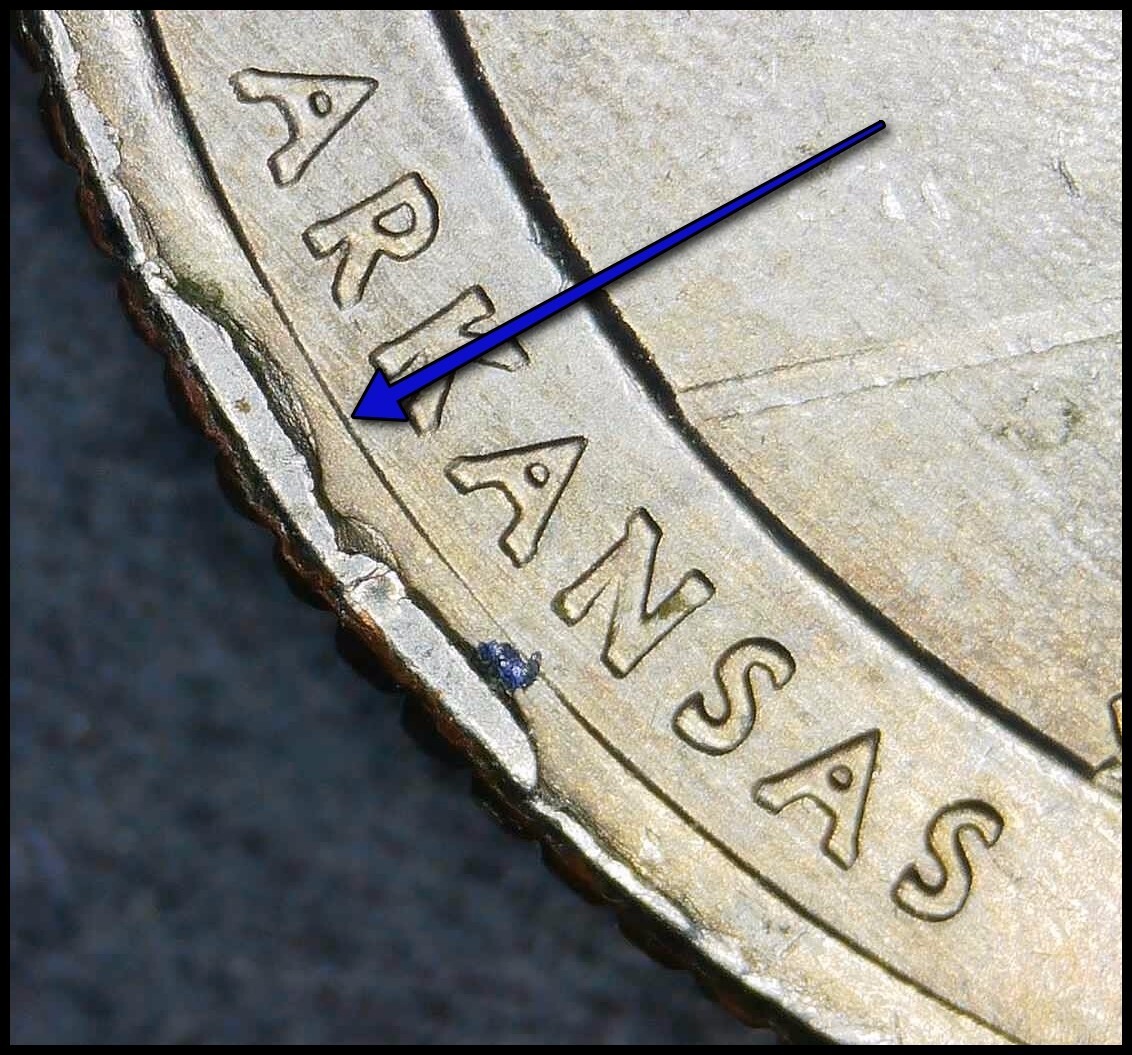
A rim cud forms when a substantial piece breaks away from the hardened working die, leaving a recessed void in the die's surface near or at the rim. When that damaged die strikes a planchet, metal flows freely into the void, producing a raised, irregular, and completely formless blob along the coin's edge — entirely devoid of design detail. On the 2010 America the Beautiful series, rim cuds have appeared on Hot Springs and other designs, with the largest examples commanding the strongest premiums from error collectors.

The key visual feature is the blob's complete absence of design — a genuine rim cud shows only flat, raised metal at the die-break location, sharply contrasting with the surrounding struck design. The size of the cud is directly correlated with collector value: small, barely-visible cuds add a modest premium, while large cuds spanning several millimeters of the rim attract bidding competition at major auction venues. Under a 10× loupe, inspect the interior edge of the cud for a clean break line where the die metal fractured.

A 2010-P Hot Springs quarter graded MS60 bearing a prominent rim cud realized $620 on eBay — one of the highest collector-to-collector sales documented for this error type on the 2010 series. The value spread between small and large cuds is wide: minor die chip cuds at the rim may bring $50 to $100, while large, visually dramatic examples in uncirculated condition routinely break $400. The Hot Springs design is the most frequently reported host coin for this variety.

How to spot it Look along the rim for a raised, blob-like area with no design detail — it will appear as a smooth or slightly rough mound of metal. Under a 10× loupe, the interior edge of the cud shows a clean fracture line. Measure the cud's width: anything over 3mm is considered large and significantly more valuable than small die chip cuds.
Mint mark Best documented on P (Philadelphia) Hot Springs MS60. Rim cuds reported on multiple 2010 designs from both P and D mints. No S (San Francisco) proof cuds confirmed in public auction records.
Notable A 2010-P Hot Springs ATB quarter graded MS60 with a large rim cud sold for $620 on eBay — one of the highest documented rim cud sales for the 2010 series. Larger cuds consistently outperform smaller die chips. Third-party grading (PCGS or NGC) adds significant credibility and typically increases realized auction prices for this error type.
MOST ACCESSIBLE

2010 Quarter Grease Struck-Through Error

$20 – $532+ 2010 Yosemite quarter grease struck-through error showing weak or missing design detail
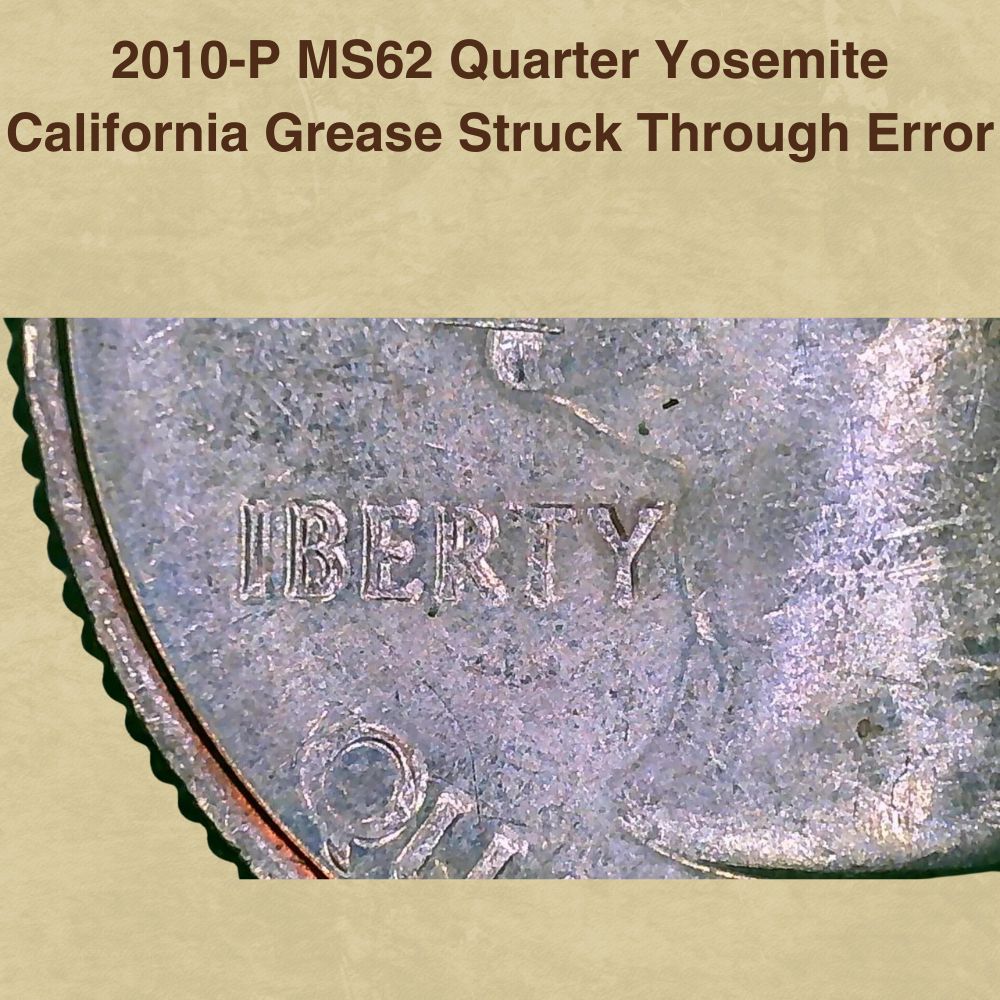
A grease struck-through error occurs when lubricating grease, die polish residue, or another foreign substance accumulates in a recess of the working die and is not cleared before striking. When the die contacts the planchet, the foreign material acts as a barrier between die and metal, preventing full detail transfer in the affected area. On 2010 quarters, grease struck-through errors have been documented across multiple designs and mints, producing coins with noticeably weakened or entirely missing design elements — lettering, portrait detail, or park scenery — in otherwise normal-looking coins.

The visual signature of a genuine grease struck-through is a soft, featureless "flat" zone within an otherwise fully struck coin. Unlike a worn area, the surrounding metal retains full mint luster, and the weak area has smooth, not abraded, surfaces. On the obverse, grease typically shows as missing or weak hair detail on Washington's portrait or absence of lettering. On the reverse, it may obscure portions of the park design. The 2010 Yosemite California issue has yielded the most publicized grease struck-through examples.

A 2010-P Yosemite quarter graded MS62 with a grease struck-through error sold for $532 on eBay, confirming meaningful collector demand even for this more common error type. Heritage Auctions sold a 2010-P Yosemite quarter graded MS60 with obverse die chip errors for $400. Lower-grade examples or those with subtle grease effects trade for $20 to $75, while dramatic examples in MS62 or better — especially those with large affected zones — can push well past $400. The accessibility of this error type makes it ideal for beginning error collectors.
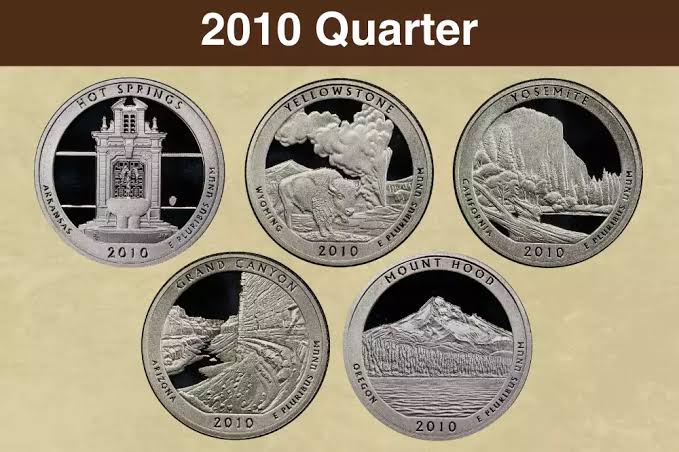
How to spot it Under a 10× loupe, identify areas of flat, featureless metal with surrounding full mint luster and normal surface quality. The weak zone has smooth, undisturbed surfaces (not abraded or worn). Weak lettering that fades gradually from normal to absent is a textbook grease struck-through signature. Tilt under angled light to confirm luster in the flat zone.
Mint mark Confirmed on P (Philadelphia) Yosemite MS60 and MS62. Reported across multiple 2010 designs from both P and D mints. The Yosemite California design has the most publicized examples.
Notable A 2010-P Yosemite grease struck-through in MS62 realized $532 on eBay. A separate 2010-P Yosemite MS60 die chip variant sold for $400 at Heritage Auctions. This is the most beginner-accessible error in the 2010 series due to relatively lower prices and high frequency. Third-party grading dramatically increases buyer confidence and realized price.

📍 Think you've spotted one of these errors on your coin?

Run the Value Calculator →

2010 Quarter Mintage & Survival Data

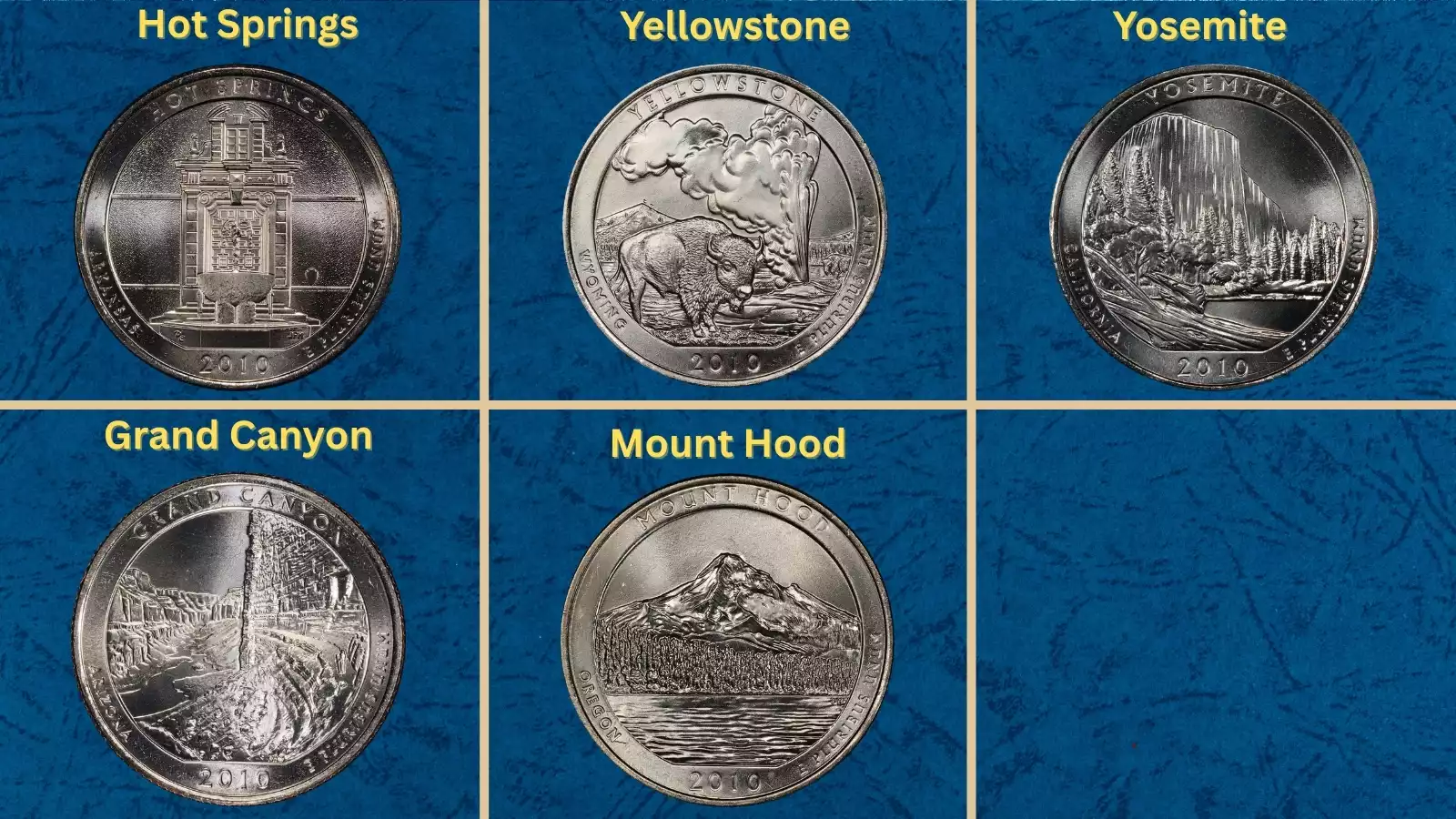
Group of 2010 America the Beautiful quarters showing all five national park designs
Design Philadelphia (P) Denver (D) S Clad Proof S Silver Proof Combined Circ.
Hot Springs (AR) 35,600,000 34,000,000 ~1,402,000 ~859,000 69,600,000
Yellowstone (WY) 33,600,000 34,800,000 ~1,404,000 ~859,000 68,400,000
Yosemite (CA) 35,200,000 34,800,000 ~1,400,000 ~859,000 70,000,000
Grand Canyon (AZ) 34,800,000 35,400,000 ~1,399,000 ~859,000 70,200,000
Mount Hood (OR) 34,400,000 34,400,000 ~1,397,000 ~859,000 68,800,000
Totals 173,600,000 173,400,000 ~7,002,000 ~4,295,000 ~347,000,000
Composition specs: 2010 circulation quarters are copper-nickel clad — an outer layer of 75% copper / 25% nickel bonded to a pure copper core. Total weight: 5.67 grams. Diameter: 24.26 mm. Edge: reeded (119 reeds). Designer: John Flanagan (obverse), individual reverse designers per park. The S-mint silver proof issues are 90% silver / 10% copper, weight 6.25 grams — and these silver proofs are NOT clad.

How to Grade Your 2010 Quarter

Condition separates a 25-cent piece from a $1,000+ collectible. Focus on Washington's cheekbone, the high points of his hair above his ear, and the fine detail in the national park reverse design — these wear first.

2010 quarter grading strip showing four condition tiers from worn to gem mint state

Worn (G–VF)

Washington's portrait is flat with little or no hair strand definition. The high points of the national park design merge together. Circulated 2010 quarters in this range are worth face value — $0.25 — regardless of design or mint mark.

Circulated (EF–AU)

Hair detail visible but slightly flat on the highest points. The cheekbone shows a trace of wear. Light friction on the park design's highest elements. Original luster shows in the recesses. Worth $0.35 to $1 depending on the specific design. AU58 specimens show only a trace of friction under magnification.

Uncirculated (MS60–64)

No wear present. Full mint luster, but contact marks and bag marks visible. Hair detail sharp throughout. Park design fully struck. Worth $2 to $25 for most designs, with Yellowstone D and Grand Canyon reaching higher in strong MS grades. A cartwheel luster visible when tilting under light confirms the grade.

Gem (MS65+)

Only the faintest contact marks visible under 10× magnification. Full, blazing mint luster. Complete strike sharpness on Washington's hair and the park design. This is where values diverge dramatically by design — Yellowstone D and Grand Canyon in MS67+ have fetched four figures. PCGS or NGC certification essential for coins at this level.

Pro tip: For 2010 clad quarters, strike quality matters as much as grade. Denver coins in this series often exhibit sharper detail on the park reverse than Philadelphia coins struck from the same dies, which is why Denver Yellowstone and Denver Grand Canyon coins dominate the top auction results even at similar numeric grades.

📷 CoinKnow compares your quarter against graded reference examples to help you match the right condition tier — a coin identifier and value app.

2010-D Yellowstone Quarter Self-Checker

The 2010-D Yellowstone quarter is the signature variety of the entire 2010 ATB series — it holds a documented Heritage Auctions record of $1,140 at MS67. Use the comparison cards and checklist below to assess whether your coin is a common find or the real premium piece.

Side-by-side comparison of common 2010-P Yellowstone quarter versus premium 2010-D Yellowstone quarter showing condition and strike differences

🔘 Common Yellowstone Quarter

Design: P mint mark (Philadelphia) or circulated D mint. Wear visible on Washington's cheekbone and hair above ear. Park reverse shows softness on the Old Faithful geyser plume and bison's head. Little to no cartwheel luster when tilted under light. Worth $0.25 to $1 in typical circulated condition.

In hand: Flat finish with no real brightness. Contact marks visible on the open fields without magnification. Grade typically F through AU. These are the vast majority of 2010 Yellowstone quarters found in pocket change.

↕ vs ↕

⭐ Premium 2010-D Yellowstone Quarter

Design: D mint mark (Denver). Zero wear on all surfaces. Full blazing cartwheel luster visible when tilting under light. Washington's hair strands individually defined. Old Faithful geyser and bison on reverse are fully struck with complete detail. No significant contact marks visible to the naked eye. Grade MS65 or higher.

In hand: Brilliant, mirror-adjacent surfaces with a warm golden sheen. Every element of the park reverse sharply delineated. At MS67 grade — the level that achieved $1,140 — only the absolute finest marks under 10× magnification are present, and luster is unbroken across the entire surface.

Does Your Yellowstone Quarter Match the Premium Profile?

Got a result? Now check what it's actually worth.

The self-checker tells you whether your coin matches the premium profile — the calculator gives you a concrete dollar estimate based on mint mark, condition, and any errors.

Use the Free Value Calculator →

Free 2010 Quarter Value Calculator

Select your coin's mint mark, condition, and any errors below — then hit Calculate for a current value estimate.

Step 1 — Select Design & Mint

Step 2 — Select Condition

Step 3 — Any Errors? (Check All That Apply)

Not sure what mint mark or condition your coin has? There's a free 2010 Quarter Coin Value Checker tool where you can upload a photo and get an AI-powered estimate without needing to know grading terminology first.

Describe Your 2010 Quarter for a Detailed Assessment

Type what you see on your coin below — we'll analyze it for potential errors, condition indicators, and value signals.

Mention these things if you can

  • Mint mark (P, D, or S)
  • Which park design (e.g. "Yellowstone," "Grand Canyon")
  • Any doubled lettering or design
  • Missing or weak areas on the coin
  • Raised lines or blobs on the surface or rim
  • Whether it looks shiny (uncirculated) or worn

Also helpful

  • Color of the coin (silver-toned, toned brown, etc.)
  • Any curved or straight section missing from the edge
  • Whether it came from a mint set or pocket change
  • Contact marks or bag marks visible
  • If it has a mirror-like surface (proof)

Where to Sell Your Valuable 2010 Quarter

Choosing the right venue can mean the difference between face value and hundreds of dollars. Match your coin's profile to the best outlet below.

🏛️ Heritage Auctions

The premier venue for high-grade 2010 quarters in MS65 or above, and for confirmed major errors. Heritage has handled the top auction results in this series — including the $1,140 Yellowstone D and the $960 Grand Canyon D. Expect 15–20% buyer's premium on realized prices. Best for coins worth $200 or more.

🛍️ eBay

The largest marketplace for 2010 error quarters and mid-grade uncirculated examples. Review recent sold prices for 2010 Yosemite quarter listings and completed sales before setting your asking price. Error coins perform especially well here — documented sales include the $620 rim cud and $532 grease struck-through. Use a BIN (Buy It Now) with Best Offer for flexibility.

🏪 Local Coin Shop

Best for quick, no-fee cash transactions on common circulated examples. Expect 40–60% of catalog value — dealers need margin to resell. Bring your coin in raw (ungraded) first to get a free assessment; if the dealer identifies it as valuable, get a second opinion from PCGS or NGC before selling outright. Ideal for bulk lots of circulated 2010 quarters.

💬 Reddit (r/Coins4Sale)

A peer-to-peer marketplace with no listing fees and an audience of engaged collectors. Works well for mid-range uncirculated examples ($10–$150) where auction house fees would eat too much of the profit. Post clear photos of both sides in natural light, state the grade and any errors clearly, and include shipping in your price. Shipping costs are typically split with the buyer.

Get it graded first: For any 2010 quarter you believe is MS65 or higher, or one with a confirmed major error (doubled die, clipped planchet, large die crack), professional certification from PCGS or NGC dramatically increases realized price. A raw (ungraded) MS67 Yellowstone D might struggle to achieve $500 — a PCGS MS67 of the same coin can fetch $1,140. Grading fees run $20–$65 per coin depending on the service tier, which is justified for any coin worth over $100.

Frequently Asked Questions

How much is a 2010 quarter worth?
Most circulated 2010 America the Beautiful quarters are worth face value — $0.25. In About Uncirculated (AU) condition they reach around $1. Mint State examples typically fetch $2 to $10, though top-grade specimens of the 2010-D Yellowstone and 2010-P Grand Canyon have sold for over $1,000 at major auction houses. Error coins can push values to $1,100 or more.
What is the most valuable 2010 quarter?
The 2010-D Yellowstone quarter holds the top regular-issue auction record at $1,140 for an MS67-graded specimen sold at Heritage Auctions in September 2017. The 2010-P Grand Canyon quarter in MS68 sold for $960 at Heritage in December 2018. Among error coins, a 2010-D Mount Hood clipped planchet graded MS65 realized $1,100, making it the highest documented error sale for the series.
What errors should I look for on a 2010 quarter?
The most valuable confirmed 2010 quarter errors include: doubled die obverse/reverse (DDO/DDR), clipped planchet errors, rim cud errors, die crack errors, and grease struck-through errors. A 2010-D Grand Canyon doubled die sold for $705 at MS65; a 2010-D Mount Hood clipped planchet brought $1,100; a 2010-D Hot Springs die crack realized $1,040; and a 2010-P Hot Springs rim cud sold for $620.
What does a 2010-D Yellowstone quarter look like?
The 2010-D Yellowstone quarter features the standard Washington portrait on the obverse with a 'D' mint mark below the date. The reverse shows the Old Faithful geyser erupting against the Wyoming sky, with a bison in the foreground. The design was released in 2010 as the second coin in the America the Beautiful series. In high grade (MS67+), the strike sharpness and luster command significant premiums.
How do I tell if my 2010 quarter is uncirculated?
An uncirculated 2010 quarter shows no wear whatsoever. Check Washington's cheekbone and the high points of his hair — any dullness, flatness, or color change indicates circulation. The reverse's national park design details should be fully sharp. Full original mint luster (a cartwheel-like sheen when you tilt the coin under light) is the clearest sign of an uncirculated specimen. MS65 and above specimens command the strongest premiums.
Where is the mint mark on a 2010 quarter?
The mint mark on a 2010 America the Beautiful quarter is located on the obverse (heads side), just below and to the right of the date '2010.' Philadelphia coins show a 'P,' Denver coins show a 'D,' and San Francisco proof coins show an 'S.' The 'S' mint quarters were struck exclusively as collector proof coins and were never released into circulation, making them easily distinguishable by their mirror-like fields.
Are 2010-S proof quarters valuable?
Standard clad 2010-S proof quarters in Deep Cameo (DCAM) condition typically trade for $3 to $20 depending on the design and grade. Silver proof versions (90% silver content) range from $9 to $36. These were sold in collector sets by the U.S. Mint and were never circulated. Mintages of about 1.4 million per design for clad and about 860,000 for silver proofs are relatively modest for the modern era.
How many 2010 quarters were made?
Approximately 347 million circulating 2010 quarters were struck across five designs at the Philadelphia and Denver mints. The Hot Springs design had the lowest combined mintage at roughly 69.6 million, while Grand Canyon had the highest at roughly 70.2 million. San Francisco struck about 1.4 million proof clad and 859,000 silver proof quarters per design for collector sets.
What is a 2010 quarter clipped planchet error worth?
A 2010 quarter with a clipped planchet error can be worth significantly more than a regular coin. In 2022, a 2010-D Mount Hood quarter graded MS65 with a curved clip error realized $1,100 at auction — the highest confirmed sale for a 2010 quarter error. Lower-grade or smaller clips trade for roughly $50 to $300 depending on the severity of the clip and the grade of the coin.
Is it worth getting a 2010 quarter professionally graded?
Professional grading by PCGS or NGC makes sense for 2010 quarters only in specific situations: coins that appear to be MS65 or higher based on full luster and no visible marks, confirmed major errors (doubled dies, clipped planchets, rim cuds, die cracks), or coins you plan to sell at auction. For common circulated examples or lower-grade uncirculated coins worth under $10, grading fees exceed the coin's value and are not recommended.

Ready to find out what your coin's worth?

Use the free 2010 quarter value calculator — instant results, no signup, no guesswork.

Calculate My 2010 Quarter Value →